
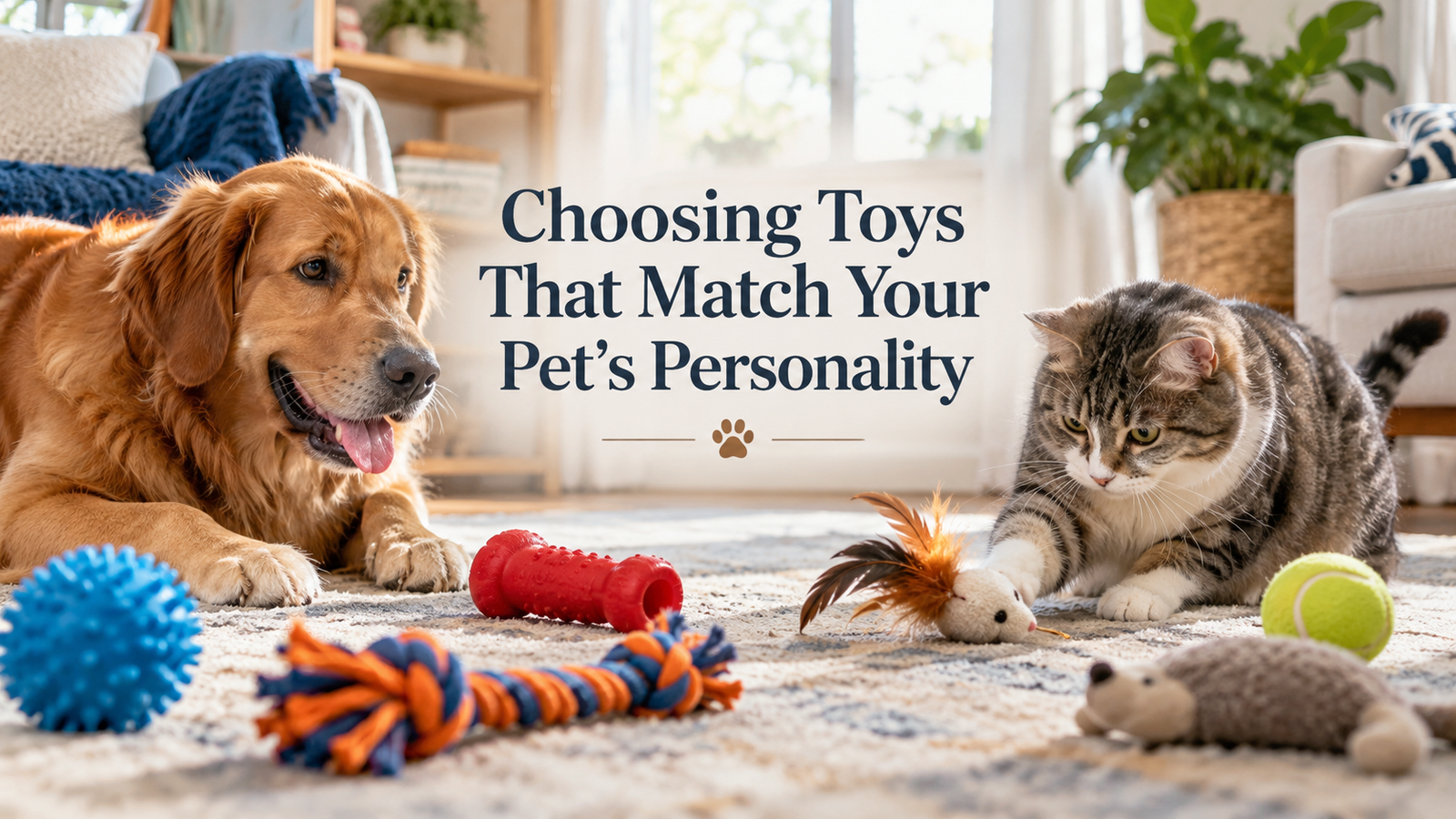
Choosing toys for a pet may look like a simple part of pet ownership, but the right toy can make a noticeable difference in your pet’s daily life. Dogs, cats, and other companion animals have individual personalities just as people do. Some pets are energetic and adventurous, while others are calm, cautious, curious, independent, or highly social. Because of these differences, a toy that keeps one pet entertained for hours may receive almost no attention from another.
Learning how to choose toys that match your pet’s personality can help you provide better mental stimulation, healthy physical activity, and meaningful interaction. Appropriate toys can also reduce boredom, encourage natural behaviors, and make everyday life more enjoyable for both you and your pet.
Instead of buying toys only because they look attractive, it is useful to observe your pet first. Their normal behavior often gives you clear clues about the type of play they enjoy most.
Understand Your Pet Before Choosing a Toy
Every pet has a preferred way of exploring the world. Some dogs immediately chase anything that moves. Others prefer carrying objects around the house. Some cats love jumping after toys, while others are happier quietly investigating boxes, tunnels, or puzzles.
Spend time watching what naturally attracts your pet.
Does your dog constantly carry socks or soft objects?
Does your cat hide and suddenly jump toward moving objects?
Does your pet enjoy searching for treats?
Does your dog become excited when you throw a ball?
Does your cat prefer playing alone rather than interacting directly with you?
These small behaviors can reveal a lot about your pet’s personality.
The best pet toys usually support behaviors the animal already enjoys. When a toy feels natural and interesting, your pet is much more likely to use it regularly.
Toys for Energetic Pets
Highly energetic pets often need toys that encourage movement. Without enough physical activity, active pets may become restless and look for their own forms of entertainment.
For active dogs, balls, retrieval toys, sturdy ropes, and chase toys can provide healthy exercise. Games such as fetch allow the dog to run while also interacting with the owner.
Some energetic dogs enjoy tug games as well. A strong rope toy can turn a short play session into useful physical activity.
Active cats often enjoy toys that move quickly. Wand toys, rolling balls, lightweight toys, and moving objects can encourage jumping, chasing, and pouncing.
Short but frequent play sessions may work better than one very long session. Cats often have bursts of energy followed by periods of rest.
Matching toys with an energetic pet’s natural desire to move can help make indoor life much more interesting.
Toys for Curious and Intelligent Pets
Some pets seem interested in everything around them. They investigate bags, cupboards, furniture, and unfamiliar objects. These animals often enjoy toys that make them think.
Puzzle toys are especially useful for curious pets.
A puzzle feeder may require the pet to move a part, roll an object, or explore different openings before receiving a small amount of food.
These activities combine play with problem solving.
Food dispensing toys can also turn an ordinary snack into a mental activity. Instead of eating quickly from a bowl, the pet has to work gradually to reach the food.
For intelligent dogs, hiding treats around a safe room can create an enjoyable searching game.
Curious cats may enjoy puzzle boxes, tunnels, treat balls, and toys containing hidden objects.
Mental exercise is important because physical activity alone does not always prevent boredom. A pet can be physically tired while still needing something interesting to think about.
Toys for Pets That Love to Chew
Chewing is normal behavior for many dogs, especially younger ones. Some adult dogs also have a strong natural desire to chew.
If a dog is repeatedly chewing household objects, providing suitable chew toys may help redirect that behavior toward something safer.
The toy should be appropriate for the dog’s size and chewing strength. A toy that is too small may create a swallowing risk, while a toy that breaks easily may not be suitable for a powerful chewer.
Check chew toys frequently for damage.
If pieces are breaking away or the toy has become significantly worn, replacing it is usually safer than continuing to use it.
Puppies going through teething may particularly appreciate suitable chew toys because chewing can provide comfort during this stage.
Rather than trying to eliminate natural chewing completely, pet owners can guide the behavior toward safer objects.
Toys for Shy or Cautious Pets
Not every animal immediately becomes excited when a new toy appears.
Shy pets may become nervous around objects that move suddenly, make loud noises, or have unfamiliar textures.
For these pets, simpler toys are often a better starting point.
A quiet soft toy may feel less intimidating than an electronic toy that moves unpredictably. A cautious cat may prefer a small lightweight toy that can be investigated from a distance.
Allow shy pets to approach new toys at their own speed.
Placing the toy nearby without forcing interaction can give the pet time to investigate it comfortably.
You can also place a familiar scent or small treat close to the toy to create a positive experience.
Confidence often develops gradually. Once a nervous pet becomes comfortable with simple toys, you can introduce slightly more interactive options.
Toys for Social Pets
Some pets enjoy playing most when another person is involved.
These highly social animals often prefer interactive toys rather than toys designed only for independent play.
Retrieval toys are excellent examples for dogs that enjoy interaction. The dog receives exercise while also spending time with its owner.
Tug toys can create another enjoyable shared activity when used appropriately.
Cats that enjoy social play may become very interested in wand toys because the owner controls the movement. The toy can imitate small prey by moving slowly, hiding briefly, and suddenly changing direction.
Interactive play strengthens communication between pets and their owners.
The toy becomes more than an object. It becomes part of a shared activity that helps build trust and companionship.

Toys for Independent Pets
Other pets are perfectly happy entertaining themselves.
Independent pets can benefit from toys that remain interesting even when the owner is busy.
Food dispensing toys, puzzle toys, balls, safe chew toys, and activity toys can encourage independent entertainment.
Cats often enjoy toys that can be pushed, chased, or carried around without human involvement.
However, independent play does not mean a pet should be left completely unsupervised with every toy.
Some toys are only safe when an owner is present. Strings, ribbons, and toys with small removable parts can create risks if the pet damages or swallows them.
Choosing toys based on both personality and safety is always important.
Consider Your Pet’s Age
Personality matters, but age should also influence your choice.
Young pets often have high energy levels and strong curiosity. Puppies may need chew toys, while kittens often enjoy lightweight toys that encourage chasing and pouncing.
Adult pets may have established preferences. By this stage, owners can often recognize whether their pet enjoys retrieving, chewing, chasing, solving puzzles, or relaxing with soft toys.
Senior pets may need gentler options.
Older dogs may still enjoy retrieving, but shorter distances and softer toys may be more comfortable. Senior cats may prefer slower moving toys that do not require large jumps.
The goal is not to stop play as pets grow older. Instead, play can be adjusted to suit their changing physical abilities.
Choose the Right Toy Size
Toy size is one of the most important safety considerations.
A toy that is suitable for a small dog may be dangerously small for a large dog. Pets should not be able to easily swallow toys intended for active play.
Very large toys can also be frustrating for small pets if they are difficult to carry or move.
Look for products designed for your pet’s approximate size, but also consider the individual animal. Two dogs of similar weight may have very different jaw strength and chewing habits.
For cats, toys should be lightweight enough to encourage play while remaining safe and durable.
Proper sizing makes play both safer and more enjoyable.
Pay Attention to Texture
Pets may have strong preferences about how toys feel.
Some dogs love soft plush toys and carry them carefully around the house. Others destroy soft toys quickly and may require stronger materials.
Some cats enjoy soft fabric toys, while others prefer lightweight plastic balls, cardboard surfaces, or textured objects.
If your pet repeatedly ignores one type of toy, the problem may simply be the texture.
Trying a few different materials can help you discover what feels most interesting to your pet.
Do Not Assume Expensive Means Better
Pets do not understand price tags.
An expensive toy may be ignored while a simple ball becomes a favorite.
The value of a toy depends on whether it suits the pet, not how much it costs.
Simple household based activities can sometimes provide excellent stimulation when they are prepared safely. A cardboard box, for example, may provide hiding and exploration opportunities for many cats.
The goal should always be safe, enjoyable engagement rather than buying the most complicated product available.
Rotate Toys to Keep Them Interesting
Leaving every toy available all the time can sometimes reduce interest.
Pets may become familiar with toys that remain constantly accessible.
Toy rotation can make old toys feel exciting again.
Keep a few toys available and store the others safely. After several days, replace some of the available toys with different ones.
When a familiar toy returns after being absent for a while, many pets show renewed interest.
Rotation can also help you learn which toys your pet genuinely prefers.
Watch How Your Pet Plays
Observation is one of the best ways to choose future toys.
If your pet repeatedly returns to the same ball, they may enjoy chasing and retrieving.
If they spend more time chewing toys than chasing them, chew focused products may be more useful.
A cat that constantly hides behind furniture before jumping toward a toy may enjoy activities that encourage stalking behavior.
Meanwhile, a pet that carefully investigates food puzzles may need more mental challenges.
Your pet is constantly giving you information through behavior. Paying attention allows you to make better choices.
Make Safety Part of Playtime
Even a toy that perfectly matches your pet’s personality should still be safe.
Inspect toys regularly for cracks, loose pieces, exposed stuffing, damaged strings, or sharp edges.
Discard badly damaged toys.
Supervise pets when introducing unfamiliar toys, especially if you are unsure how they will interact with them.
Avoid giving pets objects that can easily break into small pieces or become lodged in the mouth or digestive system.
Strings and ribbons can be particularly risky for cats if swallowed, so they should normally be used only during supervised play.
Safe play is always more important than extending the life of a damaged toy.
Use Toys to Strengthen Your Relationship
Toys can help owners communicate with their pets in positive ways.
A game of fetch, a gentle tug session, or several minutes with a cat wand gives your pet focused attention.
These moments can become part of a predictable daily routine.
Pets often learn that playtime with their owner is rewarding. Over time, this shared experience can strengthen trust and improve the relationship between pet and person.
Try to focus fully on your pet during interactive play rather than treating it as another household task.
Even ten minutes of engaged play can be more meaningful than leaving many toys on the floor without interaction.
Accept That Preferences Can Change
A pet’s favorite toys may change with age, experience, environment, and health.
A young dog that once loved endless games of fetch may later prefer slower searching games. A kitten interested in almost every moving object may become more selective as an adult.
Continue observing your pet instead of assuming their preferences will remain unchanged forever.
Introducing new types of toys occasionally can reveal new interests.
At the same time, there is nothing wrong with keeping an old favorite available if it remains safe.
Create a Balanced Toy Collection
You do not need dozens of toys.
A small but varied collection is often more useful.
You might include something for physical activity, something for chewing, something for mental stimulation, and something for interactive play.
For cats, a balanced collection could include a chase toy, a puzzle activity, a safe independent toy, and an interactive wand used under supervision.
For dogs, it might include a retrieval toy, chew toy, puzzle feeder, and tug toy.
Variety allows you to respond to your pet’s different needs throughout the day.
Final Thoughts
Choosing toys that match your pet’s personality is about understanding the individual animal in front of you. There is no single toy that every dog or cat will enjoy equally.
Watch how your pet behaves, notice what naturally attracts their attention, and choose toys that support those interests.
Energetic pets may enjoy movement based games. Curious pets may prefer puzzles. Chewers need appropriate chewing options. Shy pets often benefit from quiet and simple toys. Social pets may prefer interactive activities, while independent pets can enjoy toys designed for solo play.
Age, size, texture, durability, and safety should also guide your choices.
Most importantly, remember that toys are tools for improving your pet’s quality of life. They can provide exercise, mental stimulation, comfort, entertainment, and opportunities to bond.
When you choose toys thoughtfully rather than randomly, playtime becomes more meaningful. Your pet gets activities that actually suit their personality, and you gain a better understanding of what makes them feel happy, curious, confident, and engaged.