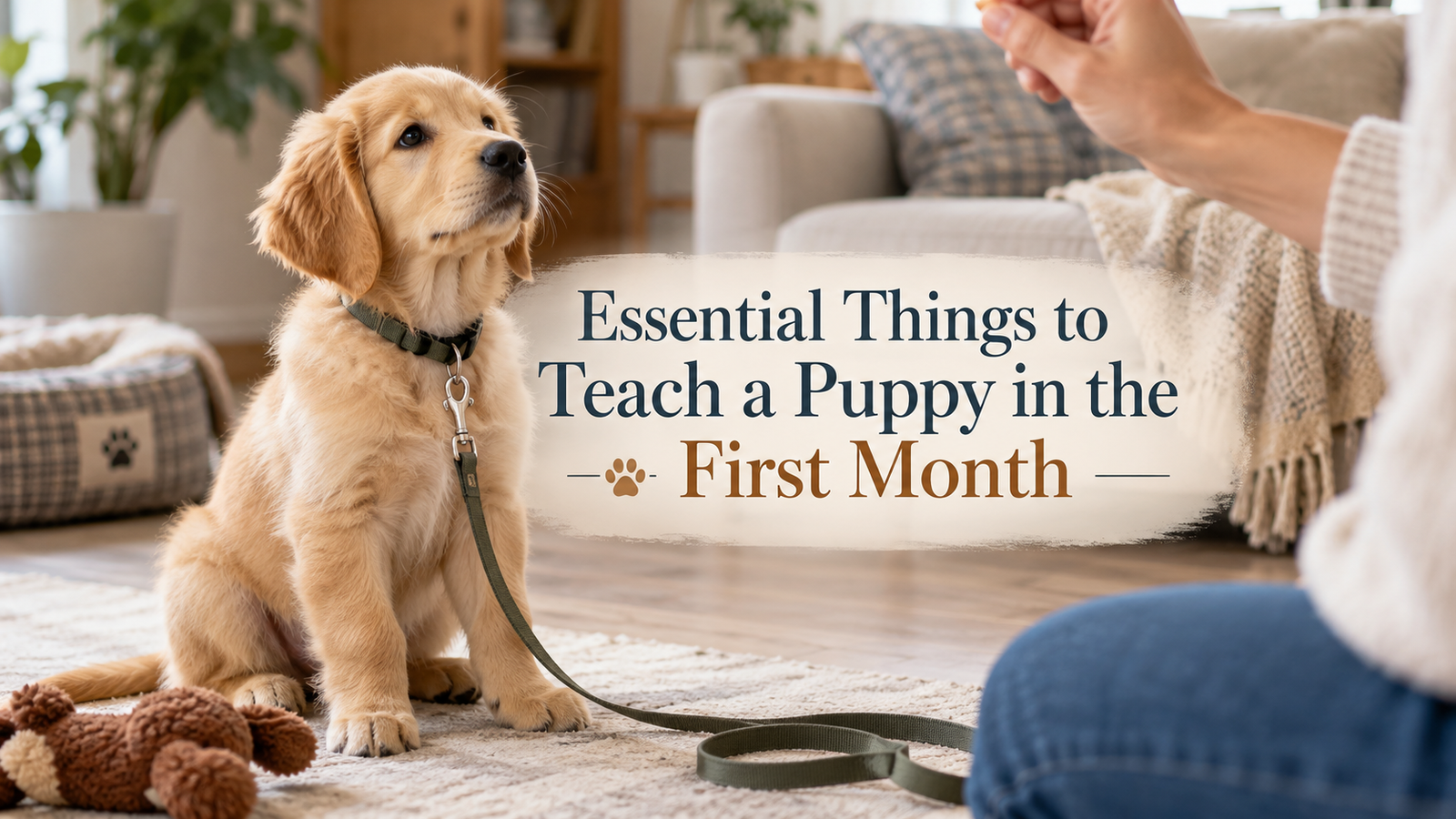
Bringing a puppy home is one of the most exciting experiences for any dog lover. A young puppy can quickly fill the house with energy, curiosity, and affection. At the same time, the first few weeks can feel challenging because your puppy is still learning how to live in a completely new environment.
The first month with a puppy is especially important because this is when many habits begin to develop. Puppies learn quickly from repeated experiences. The way you communicate, respond to behavior, introduce routines, and reward good choices can influence how your puppy behaves later in life.
You do not need to teach everything at once. The main goal during the first month should be helping your puppy feel safe while introducing simple rules and routines. Training should remain gentle, positive, and easy to understand.
Here are the essential things to teach a puppy in the first month.
Teach Your Puppy Their Name
One of the first things your puppy should learn is their name. A puppy that responds to their name is easier to communicate with during training.
Start by saying your puppy’s name in a happy and gentle voice. When the puppy looks toward you, immediately praise them or give a small reward.
Repeat this exercise several times throughout the day.
Avoid using the puppy’s name when you are angry. You want your puppy to associate their name with attention, communication, and positive experiences.
For example, say the puppy’s name once and wait. When they look at you, reward that response.
Over time, your puppy will understand that hearing their name means they should pay attention to you.
Start Toilet Training Immediately
Toilet training is one of the most important things to teach a puppy during the first month.
Young puppies have limited bladder control, so accidents are normal. Patience is essential.
Take your puppy outside regularly, especially after waking up, eating, drinking, playing, or sleeping.
Try to take them to the same toilet area each time. Familiar smells can help the puppy understand what you expect.
When your puppy goes to the toilet in the correct place, praise them immediately.
Avoid shouting or punishing a puppy for accidents inside the house. Punishment can make some puppies afraid to go to the toilet in front of their owner.
Instead, clean the area properly and continue following a consistent toilet routine.
With patience and repetition, most puppies gradually understand where they should go.
Teach a Reliable Daily Routine
Puppies usually feel more comfortable when their day follows a predictable routine.
Try to keep feeding, toilet breaks, training, play, and sleeping times relatively consistent.
For example, your puppy might wake up, go outside for a toilet break, eat breakfast, play for a short period, and then rest.
A regular routine can help your puppy understand what happens throughout the day.
It can also make toilet training easier because you begin to recognize when your puppy is likely to need a bathroom break.
The schedule does not have to be perfect. The important thing is creating general consistency.
Teach Your Puppy to Come When Called
Recall training is one of the most valuable skills you can teach your puppy.
Start inside the house where there are very few distractions.
Move a short distance away from your puppy and call their name followed by a simple word such as “come.”
When your puppy approaches you, praise them enthusiastically and reward them.
Never punish your puppy after they come to you, even if they were doing something unwanted before coming.
You want your puppy to believe that approaching you is always a good decision.
Practice recall in short sessions every day.
As your puppy improves, you can gradually practice from longer distances and in areas with more distractions while keeping safety in mind.
Introduce the Sit Command
Sit is one of the easiest basic commands for many puppies to learn.
Hold a small reward near your puppy’s nose. Slowly move it slightly upward and backward over their head.
As your puppy follows the reward with their eyes, their bottom will often naturally move toward the floor.
When your puppy sits, say “sit” and reward them.
Keep the training sessions short.
Young puppies often lose concentration quickly, so several short training sessions are usually better than one long session.
Once your puppy understands the action, gradually reduce how much you rely on food or hand movement.
Teach Gentle Mouth Behavior
Puppies naturally explore the world using their mouths. They may bite hands, clothing, furniture, or anything else they can reach.
Some puppy biting is completely normal, especially during teething.
However, puppies should gradually learn that human hands are not chew toys.
If your puppy bites your hand during play, stop interacting for a few seconds. Offer an appropriate puppy toy instead.
When the puppy plays with the toy, praise them.
This helps teach your puppy what they are allowed to chew.
Avoid encouraging rough hand wrestling because it can make biting more exciting for the puppy.
Consistency is important. Everyone in the household should follow similar rules about biting.
Teach Your Puppy What They Can Chew
Chewing is another normal puppy behavior.
Puppies may chew because they are teething, curious, excited, or bored.
Instead of trying to stop chewing completely, teach your puppy what items are appropriate to chew.
Provide safe puppy toys with suitable textures.
If your puppy starts chewing furniture, shoes, or household objects, calmly redirect them toward an appropriate toy.
Praise them when they choose the toy.
Keeping valuable items away from the puppy can also prevent bad habits from developing.
Good puppy management is often just as important as training.
Begin Crate Training Positively
A crate can provide a puppy with a comfortable place to rest when introduced properly.
Never use the crate as punishment.
Place comfortable bedding inside and allow your puppy to explore the crate voluntarily.
You can place treats or toys inside to create a positive association.
At first, keep the crate door open.
Once your puppy feels comfortable, you can briefly close the door while remaining nearby.
Gradually increase the amount of time your puppy spends inside.
The goal is for your puppy to view the crate as a safe resting place rather than somewhere they are forced to stay.
Teach Calm Handling
Your puppy will need to be handled throughout life for grooming, veterinary visits, nail care, and health checks.
The first month is a good time to introduce gentle handling.
Briefly touch your puppy’s ears, paws, legs, tail, and body while keeping the experience calm.
You can reward your puppy afterward.
You can also gently look inside the puppy’s ears or lift a paw for a few seconds.
Do not force the puppy if they appear frightened or uncomfortable.
The goal is to gradually teach them that being touched and examined is normal and safe.
This early preparation can make future grooming and veterinary care much easier.
Introduce the Collar and Leash
Your puppy should gradually become comfortable wearing a properly fitted collar or harness.
At first, they may scratch at it or act confused. This is normal.
Allow them to wear it for short periods while playing or eating.
Once they are comfortable, introduce a lightweight leash.
Practice walking a few steps inside the house before moving to more distracting environments.
Avoid pulling your puppy around using the leash.
Instead, encourage them to follow you.
Praise the puppy whenever they walk calmly near you.
Early leash training creates a strong foundation for polite walking later.
Teach Your Puppy to Be Comfortable Alone
It can be tempting to spend every minute with a new puppy, but your puppy should also learn that being alone for short periods is normal.
If puppies receive constant attention during their first weeks, some may struggle when their owners eventually need to leave.
Start with very short periods of separation.
Place your puppy somewhere safe with a comfortable bed or appropriate toy and step away briefly.
Return calmly.
Gradually increase the duration as the puppy becomes comfortable.
Avoid making every departure and return extremely exciting.
Calm routines can help your puppy understand that separation is temporary and normal.
Begin Safe Socialization
Socialization is one of the most important parts of puppy development.
A young puppy should gradually experience different people, sounds, surfaces, objects, and environments.
Introduce these experiences carefully.
Your puppy might hear household appliances, walk on grass, see people wearing different clothing, experience gentle car rides, or meet calm visitors.
The goal is not to expose the puppy to everything at once.
Instead, create positive and controlled experiences.
Never force a frightened puppy toward something they are trying to avoid.
Allow them to observe from a comfortable distance.
Because young puppies may not have completed their vaccination schedule, ask your veterinarian about safe socialization and suitable public environments.
Teach Calmness Around Food
Mealtime can also become a useful training opportunity.
Before placing the food bowl down, wait for a brief moment of calm behavior.
You do not need to demand perfect obedience from a very young puppy.
Even one or two seconds of calm behavior can be rewarded by placing the bowl down.
This simple habit helps teach patience.
Avoid repeatedly taking food away from your puppy to test them. This can sometimes create unnecessary anxiety around food.
Instead, create positive experiences around feeding.
Occasionally walking past and adding something enjoyable to the bowl can help your presence around food feel positive.
Teach Simple Boundaries
Your puppy should gradually learn the household rules.
Perhaps you do not want the puppy jumping on furniture, entering certain rooms, or chewing particular objects.
Decide on your rules early and keep them consistent.
Changing the rules repeatedly can confuse a puppy.
For example, allowing your puppy on the sofa one day and becoming angry about it the next day makes it difficult for the puppy to understand what you expect.
Use barriers, puppy gates, closed doors, and supervision to make good behavior easier.
Teaching boundaries is often easier when you prevent unwanted behavior before it happens.
Reward Calm Behavior
Owners often notice puppies when they are jumping, barking, biting, or stealing objects.
However, calm behavior also deserves attention.
If your puppy is quietly resting, sitting politely, or playing calmly with a toy, gently praise them.
This teaches the puppy that calm behavior can also earn positive attention.
Over time, rewarding calm moments can help develop a puppy that is better able to settle inside the house.
Keep Training Sessions Short
Puppies have short attention spans.
You do not need twenty or thirty minute training sessions.
A few minutes at a time can be enough.
You can practice sit before meals, recall during play, or calm behavior before opening a door.
Small training opportunities throughout the day often feel more natural than long formal sessions.
Stop while your puppy is still interested.
Training should feel enjoyable rather than exhausting.
Use Positive Reinforcement
Positive reinforcement is one of the most effective ways to teach a puppy.
When your puppy does something you like, reward that behavior.
Rewards can include food, praise, toys, affection, or play.
Different puppies value different rewards.
The important thing is timing.
Reward the puppy soon after the correct behavior so they can understand what earned the reward.
Try to avoid physical punishment or frightening training methods.
Fear may stop behavior temporarily, but it does not necessarily teach the puppy what you want them to do instead.
Clear guidance and positive reinforcement usually create better communication between a puppy and owner.
Make Sleep a Priority
Young puppies need a surprising amount of sleep.
An overtired puppy may become more energetic, bite more, struggle to focus, or appear restless.
Provide a quiet and comfortable sleeping area.
Allow your puppy to nap regularly during the day.
Do not expect a young puppy to remain active with the family all day.
Rest plays an important role in physical development, learning, and emotional regulation.
A good puppy routine should include plenty of opportunities for sleep.
Build Trust Before Expecting Perfection
The first month should not be about creating a perfectly trained dog.
Your puppy has recently left a familiar environment and is learning an entirely new way of life.
Focus on building trust.
Be patient when mistakes happen.
Celebrate small improvements.
A puppy that feels safe around you will usually be more willing to learn.
Training becomes easier when your puppy views you as a consistent and trustworthy guide.
Common Mistakes to Avoid During the First Month
One common mistake is expecting too much too quickly.
A puppy cannot understand every household rule within a few days.
Another mistake is being inconsistent.
If different family members use different commands or rules, the puppy may become confused.
Too much freedom inside the house can also cause problems.
Supervise your puppy carefully and use safe areas when you cannot watch them.
Finally, avoid overwhelming your puppy with too much training, social activity, or stimulation.
Learning should happen gradually.
Final Thoughts
Understanding the essential things to teach a puppy in the first month can make the transition into your home much easier. The early weeks should focus on toilet training, name recognition, recall, basic commands, gentle handling, appropriate chewing, leash introduction, socialization, calm behavior, and a consistent daily routine.
You do not need to rush.
Every puppy develops at a slightly different pace. Some puppies quickly understand new commands, while others need more repetition and encouragement.
What matters most is consistency.
Use simple instructions, reward good behavior, provide appropriate boundaries, and give your puppy enough time to rest and adjust.
The lessons your puppy learns during the first month can become the foundation for many years of good behavior. When training is based on patience, trust, and positive experiences, you are not simply teaching commands. You are helping your puppy understand how to live confidently and comfortably as part of your family.