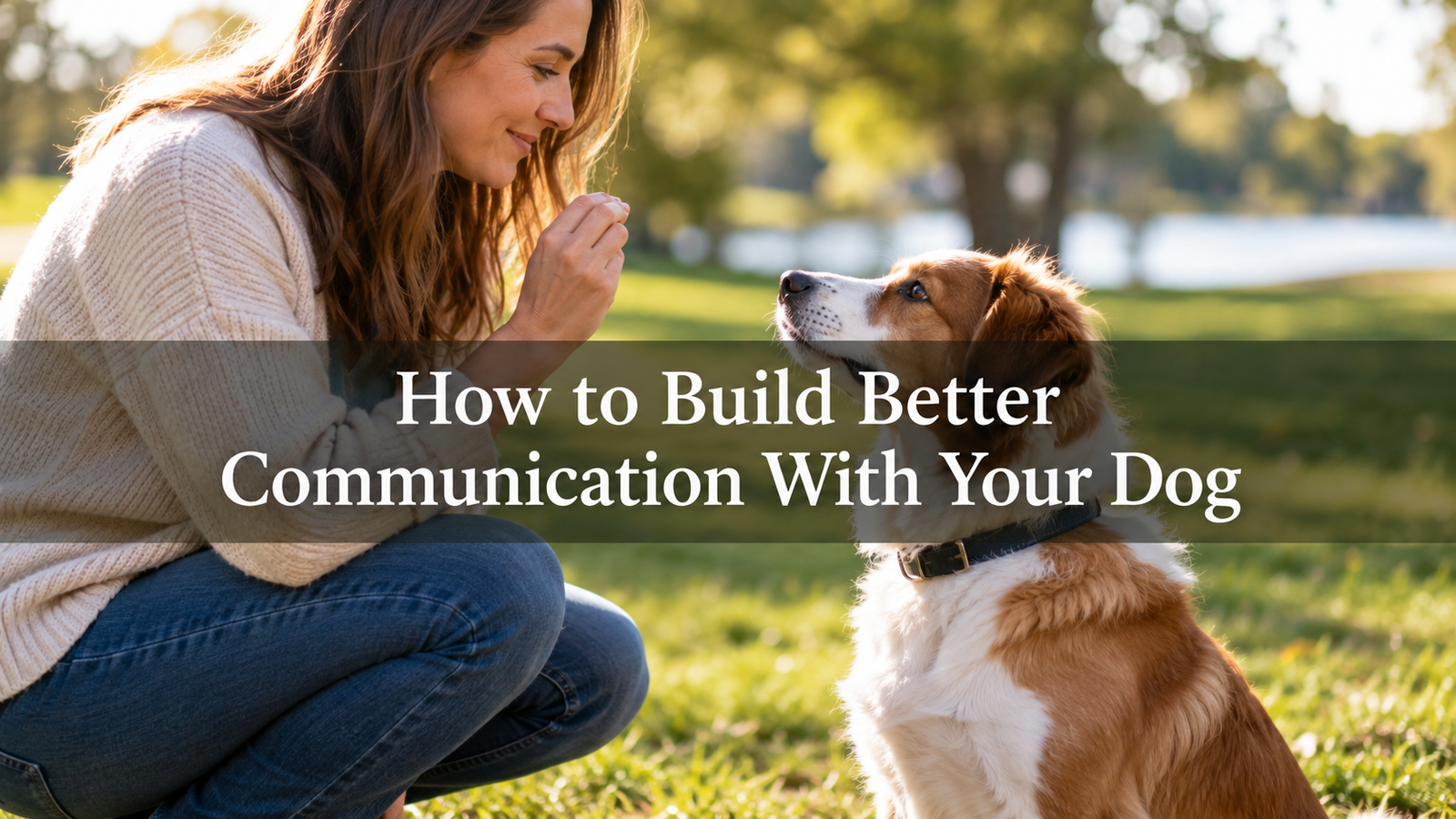
Building better communication with your dog is one of the most important parts of creating a happy and trusting relationship. Dogs may not understand human language in the same way we do, but they are excellent at reading body language, tone of voice, facial expressions, routines, and emotional signals. At the same time, dogs are constantly communicating with us through their posture, eyes, ears, tail, movements, and behavior.
When I began learning more about dog behavior, one lesson became very clear. Good communication with a dog is not simply about teaching commands. It is about learning how your dog communicates and making your own signals easier for your dog to understand.
Many behavior problems develop because the dog and owner are sending different messages. A dog may not understand what is expected, while the owner assumes the dog is being stubborn. Improving communication can make training easier, reduce frustration, and help your dog feel more secure around you.
Understand How Dogs Communicate
The first step in building better communication with your dog is learning to observe your dog carefully.
Dogs communicate mostly through body language. Their entire body can tell you something about how they are feeling. The position of the ears, tail, mouth, head, and body can provide useful information.
A relaxed dog may have a soft face, loose body movement, relaxed ears, and a natural tail position. A worried dog may lower its body, turn its head away, lick its lips, yawn, or avoid eye contact.
A dog that suddenly becomes very still may also be uncomfortable, even if it is not barking or growling.
The more time you spend watching your dog in different situations, the easier it becomes to recognize these signals.
Do not focus on only one part of the body. For example, a wagging tail does not always mean a dog is happy. Look at the dog’s complete posture and the situation around it.
Use Simple and Consistent Words
One of the easiest ways to improve communication with your dog is to use clear and consistent words.
Dogs can learn many verbal cues, but constantly changing your words can cause confusion.
If you use the word “come” when calling your dog, try to use the same word every time. Do not say “come,” then “come here,” then “get over here,” while expecting your dog to understand that every phrase has exactly the same meaning.
The same principle applies to commands such as sit, stay, down, wait, and leave it.
Family members should also try to use the same words. If one person says “down” when asking the dog to lie down while another person uses “down” to stop jumping, the dog may become confused.
Simple language makes dog training much easier.
Pay Attention to Your Tone of Voice
Dogs often pay as much attention to how we speak as they do to the actual words.
A calm and friendly tone can make your dog feel comfortable and interested in interacting with you. A harsh or angry voice may cause fear, stress, or uncertainty.
When giving normal commands, use a clear and confident voice without shouting.
When praising your dog, a warm and cheerful tone can help communicate that the dog has done something correctly.
Dogs are very sensitive to emotional changes in our voices. If you sound frustrated while asking your dog to perform a familiar behavior, your dog may become nervous and perform worse.
Staying calm usually produces better communication than becoming louder.
Make Your Body Language Clear
Your dog is always watching your movements.
Humans often communicate one thing with their voice and another thing with their body without realizing it.
Imagine asking your dog to come while leaning forward and staring directly at the dog. Some dogs may find that posture uncomfortable. Turning slightly sideways and using a welcoming gesture may make the dog more willing to approach.
Hand signals can also be very helpful during training.
Many dogs learn visual signals quickly because body movement is already a natural part of canine communication.
You can combine a hand signal with a verbal command and gradually teach your dog to understand both.
Whatever signals you choose, try to keep them consistent.
Learn to Listen to Your Dog
Communication is a two way process.
Owners often spend most of their time telling dogs what to do, but good communication also requires listening to what the dog is trying to say.
Your dog may communicate discomfort by moving away from a situation. It may communicate excitement by jumping or running. It may show uncertainty by slowing down or refusing to move forward.
Instead of immediately correcting the behavior, ask yourself what may be causing it.
For example, if your dog refuses to walk toward a particular object, there may be something about that object that makes the dog nervous.
Understanding the reason behind a behavior often helps you respond more effectively.
Reward the Behavior You Want
Dogs learn from the results of their actions.
When a behavior leads to something pleasant, the dog is more likely to repeat it.
This makes positive reinforcement one of the clearest ways to communicate with your dog.
Rewards do not always have to be food. Praise, toys, play, attention, and access to something enjoyable can all be valuable rewards.
Suppose your dog sits calmly before you open the front door. Opening the door can become the reward for calm behavior.
If your dog walks politely toward the park, continuing the walk can become a reward.
When you reward good choices, you are clearly showing your dog which behaviors work.
Choose the Right Time for Training
Timing plays an important role in dog communication.
If you praise your dog several seconds after it performs a behavior, it may not understand what the praise was for.
Try to reward the desired behavior immediately.
The same principle applies when redirecting unwanted behavior. Dogs understand consequences best when they happen close to the action.
Training sessions should also be kept manageable.
A dog that is tired, distracted, stressed, or extremely excited may struggle to focus. Short sessions are often more productive than long lessons.
You can practice simple skills throughout the day instead of turning every training session into a formal event.
Ask your dog to sit before meals. Practice waiting before opening a door. Call your dog to you during play and then allow the game to continue.
Everyday situations are excellent opportunities for communication.
Avoid Repeating Commands Again and Again
One common training mistake is repeating a command many times.
An owner might say, “sit, sit, sit, sit” until the dog finally sits.
Over time, the dog may learn that the first command does not matter.
Give the cue clearly once and allow your dog a moment to respond.
If the dog does not understand, make the task easier or guide the dog using a method it already knows.
Repeated commands can become background noise.
Clear communication means making each signal meaningful.
Understand Your Dog’s Individual Personality
Every dog is different.
Some dogs are naturally confident and social. Others are quiet, sensitive, independent, energetic, or easily distracted.
Good communication requires adapting your approach to the dog in front of you.
A highly energetic dog may need some physical activity before it can concentrate on training. A sensitive dog may respond better to gentle encouragement and quiet sessions.
A confident dog might enjoy learning in busy environments, while a nervous dog may need to begin somewhere peaceful.
Do not compare your dog’s learning speed with another dog.
Focus on understanding your dog’s personality, motivation, and comfort level.
Build Trust Through Predictable Routines
Dogs often feel more secure when their daily life is reasonably predictable.
Regular feeding, walking, play, rest, and training routines help your dog understand what to expect.
This does not mean every minute of the day must follow a strict schedule. It simply means creating enough consistency that your dog can recognize normal patterns.
Predictability also improves communication because your dog begins to understand what certain actions mean.
Picking up the leash may signal a walk. Preparing the food bowl may signal mealtime. Sitting in a particular place may signal a training session.
These routines create a shared language between you and your dog.
Respect Your Dog’s Personal Space
Not every dog enjoys constant touching, hugging, or close contact.
Part of communicating well with your dog is noticing when your dog wants interaction and when it needs space.
A dog that moves away during petting may be asking for a break. Respecting that request helps build trust.
You can also learn where your dog enjoys being touched. Many dogs prefer gentle rubbing around the chest or shoulders, while some may dislike having their paws, tail, or head handled.
Respectful interaction teaches your dog that communication works.
When the dog realizes that subtle signals are noticed, it may be less likely to use stronger signals such as growling.
Use Eye Contact Carefully
Eye contact can be useful in training because it helps your dog focus on you.
You can teach your dog to look toward you when you say its name. Rewarding this behavior can make communication much easier during walks, training sessions, and distracting situations.
However, prolonged staring can make some dogs uncomfortable.
Use relaxed eye contact rather than intense staring.
The goal is to encourage your dog to check in with you naturally.
A dog that regularly looks toward its owner for information is usually easier to guide through new situations.
Give Your Dog Time to Process Information
Dogs sometimes need a moment to understand what you are asking.
Owners may give a command and expect an immediate response. When nothing happens, they quickly repeat the command or become frustrated.
Instead, give your dog a short moment to think.
Learning involves processing information. This is especially important when your dog is practicing a new skill.
Patience improves communication because it gives the dog an opportunity to make the correct choice.
Communicate During Walks
Walks are excellent opportunities for improving communication with your dog.
Instead of allowing every walk to become a constant pulling contest, encourage your dog to pay attention to your movement.
Change direction occasionally. Reward your dog for walking near you. Allow time for sniffing because exploring through scent is an important part of a dog’s experience.
You can also practice simple commands during walks.
Ask for a sit before crossing a road. Practice looking at you when another dog appears at a comfortable distance. Reward calm walking when passing distractions.
These small interactions strengthen communication in real situations.
Do Not Punish Warning Signals
Growling is an important form of canine communication.
Although people may find it unpleasant, a growl often means the dog feels uncomfortable and wants more distance.
Punishing a dog for growling can remove the warning without removing the uncomfortable emotion behind it.
Instead, try to understand what triggered the growl.
Move the dog away from the situation when appropriate and work on the underlying cause using safe training methods.
Listening to warning signals is an important part of responsible communication.
Spend Quality Time Together
Communication improves through shared experience.
Training is helpful, but simply spending enjoyable time together also strengthens your relationship.
Play games your dog enjoys. Explore different walking routes. Practice easy tricks. Sit quietly together. Allow your dog to sniff and investigate safe environments.
These experiences teach you more about your dog’s personality and preferences.
Your dog also becomes more familiar with your movements, routines, and expectations.
Strong communication develops naturally when both dog and owner regularly interact in positive ways.
Be Patient With Mistakes
Dogs will make mistakes during training.
Sometimes they become distracted. Sometimes they misunderstand a command. Sometimes the environment is simply too difficult.
Mistakes are part of learning.
Instead of becoming frustrated, look at the situation and decide how you can make your message clearer.
Perhaps the reward is not interesting enough. Maybe the environment has too many distractions. The dog might also need more practice with an easier version of the behavior.
Good trainers do not simply ask why the dog failed. They also ask how they can communicate better.
Final Thoughts
Learning how to build better communication with your dog takes time, observation, patience, and consistency. The goal is not to make your dog obey every word instantly. The real goal is to create a relationship in which both you and your dog understand each other more clearly.
Pay attention to your dog’s body language. Use simple commands and consistent signals. Reward good behavior at the right moment. Respect your dog’s emotions and personal space. Most importantly, remember that communication works in both directions.
Your dog is communicating with you every day, even when it does not make a sound.
Once you learn to notice those signals, everyday activities such as walking, playing, feeding, and training become easier and more enjoyable. Better communication can reduce confusion, improve behavior, strengthen trust, and help your dog feel safer around you.
A strong relationship with a dog is built through thousands of small interactions. Every time you listen, respond calmly, and make your expectations clear, you are improving that relationship.
With patience and consistent practice, you and your dog can develop a shared understanding that makes life together more peaceful, enjoyable, and rewarding.