Cats may not speak our language, but they communicate almost constantly. A small movement of the tail, a change in ear position, a slow blink, or even the way a cat sits can reveal a great deal about how it feels. Learning to understand common cat body language signals can make life easier for both cats and their owners because it allows us to recognize comfort, fear, excitement, irritation, and affection before the situation becomes confusing.
When I first started reading about cat behavior, I realized that many signals people consider random are actually meaningful. Cats rely heavily on body posture because it helps them communicate without making unnecessary noise. Their ancestors needed to avoid attracting attention while hunting or protecting themselves, so subtle communication became an important part of feline behavior.
Understanding cat body language is not about memorizing one signal at a time. A cat should always be observed as a whole. The ears, eyes, tail, whiskers, posture, and surrounding situation all work together. Once you learn to connect these signs, your cat becomes much easier to understand.
Why Cat Body Language Is Important
Understanding common cat body language signals helps owners respond appropriately to their pets. A cat that appears unfriendly may actually be frightened. Another cat that seems relaxed may be becoming overstimulated during petting.
Recognizing these differences allows you to respect your cat’s boundaries. It can also prevent scratching, biting, stress, and misunderstandings.
Body language can sometimes provide early clues that something is wrong. A normally social cat that suddenly hides, crouches, or becomes unusually defensive may be experiencing stress or discomfort. Behavioral changes should not automatically be considered a medical problem, but persistent changes deserve attention.
Every cat has its own personality, so observation is important. The more time you spend watching your cat in different situations, the easier it becomes to recognize what normal behavior looks like.
Understanding Cat Tail Language
The tail is one of the most expressive parts of a cat’s body. Its position and movement can provide useful information about mood.
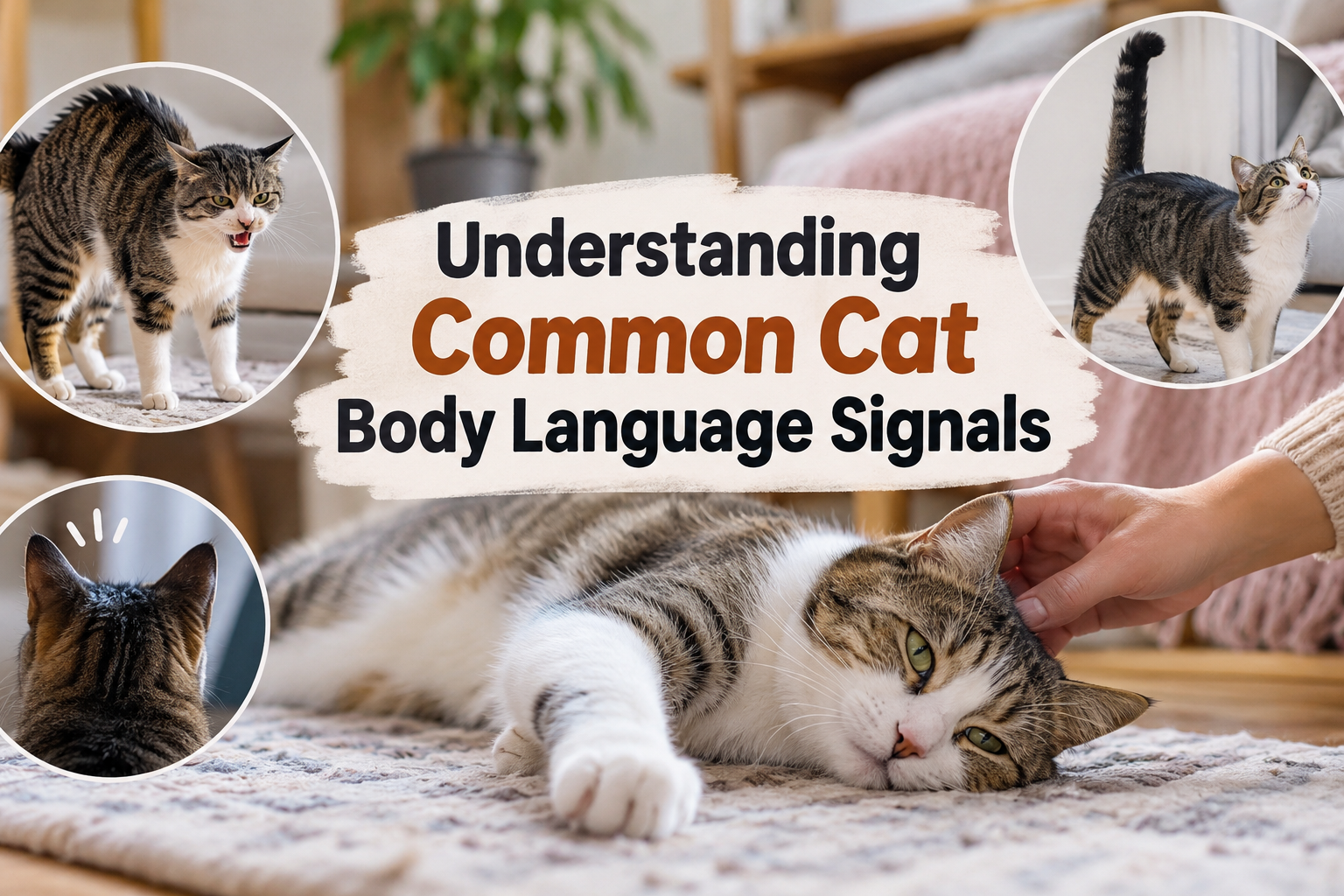
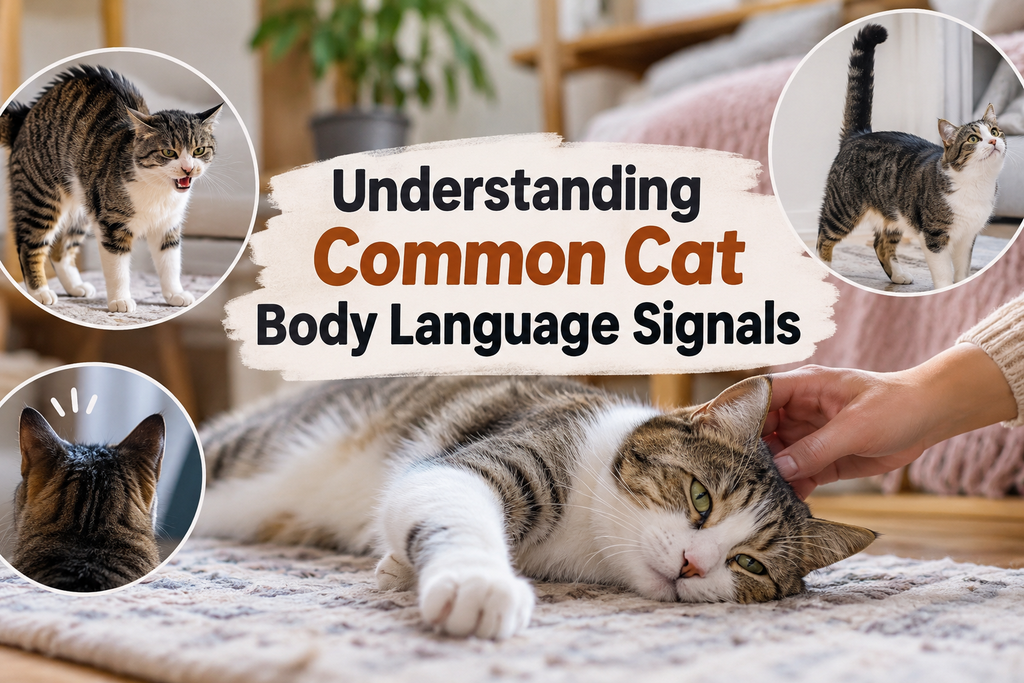
A cat walking toward you with its tail held upright usually feels confident and comfortable. Many cats use this posture when greeting people they trust. A slight curve at the top of the tail can make the greeting look even more relaxed.
A rapidly moving tail can have a very different meaning. Unlike dogs, cats do not usually wag their tails because they are happy. Strong tail movements often indicate excitement, frustration, or irritation.
If your cat begins strongly flicking its tail while being stroked, it may be telling you that it has had enough attention. Stopping before the cat becomes more annoyed can prevent a scratch or bite.
A tail tucked close to the body may indicate fear or insecurity. A puffed tail usually appears when a cat feels frightened or threatened. The cat is attempting to make itself look larger to discourage whatever it considers dangerous.
Tail language becomes more accurate when you observe the rest of the body as well.
What Your Cat’s Ears Are Telling You
Cat ears are extremely mobile and can reveal changes in emotion very quickly.
Forward facing ears usually indicate interest, comfort, or curiosity. You may notice this position when your cat watches a bird through the window or approaches something interesting.
Ears that turn slightly sideways can indicate uncertainty. The cat may be listening carefully while deciding how it feels about a situation.
Flattened ears are more serious. They can be associated with fear, anger, stress, or defensive behavior. When a cat presses its ears tightly against its head, giving it more space is usually a sensible response.
You may also notice your cat rotating its ears toward different sounds. This does not necessarily indicate stress. Cats have excellent hearing and naturally move their ears to locate sounds around them.
Always consider ear position together with the eyes and overall posture.
Reading Your Cat’s Eyes
The eyes play an important role in feline communication.
A relaxed cat often has soft eyes with partially closed eyelids. If your cat looks at you and slowly closes and opens its eyes, it is performing what many owners call a slow blink.
Slow blinking is generally associated with relaxation and trust. You can gently slow blink back at your cat by relaxing your face and slowly closing your eyes.
Wide eyes may indicate excitement, surprise, fear, or intense attention depending on the situation.
The pupils also provide useful clues. Enlarged pupils can occur during play, excitement, darkness, fear, or stress. Narrow pupils can appear in bright light but may also accompany intense focus.
Because lighting strongly affects pupil size, pupils should never be interpreted alone.
Direct staring can sometimes feel threatening to cats, especially when it comes from an unfamiliar person or animal. A relaxed gaze with occasional blinking is generally less intimidating.
Understanding Whisker Position
Whiskers do much more than help cats navigate small spaces. Their position can also reflect emotion.
A relaxed cat usually holds its whiskers naturally toward the sides of the face. When something catches its attention, the whiskers may move forward as the cat investigates.
Whiskers pulled backward toward the cheeks may suggest fear, nervousness, or discomfort.
You may notice forward pointing whiskers when your cat is hunting a toy. This often reflects concentration and excitement.
Because whisker movements can be subtle, they are easiest to understand when combined with other signals such as ear position and body posture.
Relaxed Cat Body Language
A relaxed cat usually looks physically loose rather than tense.
It may lie on its side, curl comfortably on a bed, or sit with its paws tucked underneath its body. The ears are generally neutral or facing forward, while the eyes appear soft.
Some relaxed cats expose their stomach while sleeping or resting. Although this often demonstrates trust, it does not automatically mean the cat wants its belly rubbed.
The stomach is a vulnerable area, and many cats instinctively protect it. A cat may happily lie with its belly exposed but grab your hand when you attempt to touch it.
Respecting this signal helps maintain trust.
Another common sign of relaxation is kneading. Cats sometimes push their front paws repeatedly against blankets, furniture, or people. This behavior begins during kittenhood and often appears when adult cats feel comfortable.
Signs of Fear in Cats
Fear can appear differently depending on the individual cat and the situation.
A frightened cat may crouch close to the floor and attempt to make itself less noticeable. Its ears may flatten, pupils may enlarge, and whiskers may move backward.
Some cats run and hide when frightened. Others become defensive because they feel they cannot escape.
A fearful cat may hiss, growl, swat, or raise its fur. These behaviors should not automatically be interpreted as aggression. The cat may simply be asking for distance.
Forcing interaction usually makes fear worse.
If your cat is frightened, give it access to a quiet and secure place. Allow it to approach again when it feels safe.
Learning to recognize fear before the cat reaches the hissing or swatting stage can improve your relationship significantly.
Signs That a Cat Is Becoming Irritated
Cats usually provide warnings before becoming seriously irritated, but these signs are easy to miss.
Imagine that you are petting your cat and everything seems fine. After a short time, the end of the tail begins moving. The ears rotate slightly sideways. The cat’s muscles become tense and its skin may twitch.
These small changes may indicate that the cat has had enough.
Continuing to touch the cat despite these signals may lead to a sudden bite or swat. From the owner’s perspective, the reaction may appear unexpected. From the cat’s perspective, several warnings may already have been given.
Learning to stop interaction when these signals appear teaches the cat that communication works.
Playful Cat Body Language
Play is another situation where feline body language can look intense.
A playful cat may crouch before suddenly running toward a toy. Its pupils may become larger, ears may point forward, and whiskers may move toward the object of interest.
Young cats sometimes perform sideways jumps with an arched body during energetic play. This may look dramatic, but the surrounding situation helps determine whether the cat is frightened or simply excited.
A playful cat generally remains flexible and continues returning to the activity voluntarily.
Play behavior often contains movements similar to hunting because cats naturally practice stalking, chasing, pouncing, and grabbing.
Providing appropriate toys gives cats a safe way to express these natural behaviors.
How Cats Show Affection
Cats can be extremely affectionate, although their affection may be more subtle than people expect.
Head rubbing is one common example. A cat may rub its cheeks or forehead against your hand or legs. Cats have scent glands around the face, and rubbing is associated with social familiarity and scent communication.
Some cats gently bump their forehead against people they trust.
Slow blinking is another common sign of comfort and positive social interaction.
A cat that chooses to sleep beside you is also demonstrating trust. Sleeping places animals in a vulnerable position, so cats usually select locations where they feel secure.
Following you around the house can sometimes be another indication that your cat enjoys your company, particularly if its posture remains relaxed.
Purring is commonly associated with happiness, but it should be interpreted carefully. Cats can also purr in stressful situations. Context matters.
What an Arched Back Means
An arched back does not always have the same meaning.
If a cat arches its back while its fur stands upright and its body becomes stiff, the cat is probably frightened or defensive. It is attempting to make itself appear larger.
However, some cats arch their backs when stretching after waking up. Others lift their backs toward your hand while enjoying petting.
The meaning becomes clear when you examine the entire situation.
This is a good example of why interpreting one body movement alone can lead to mistakes.
Signs Your Cat Wants Space
One of the most useful skills for any cat owner is recognizing when a cat wants to be left alone.
Moving away from you is an obvious signal. Turning the head repeatedly, flattening the ears, flicking the tail, stiffening the body, or avoiding contact can also indicate that interaction is becoming uncomfortable.
Allowing the cat to leave is important.
Cats often develop stronger relationships with people who respect their boundaries because they learn that they have control over social interaction.
Instead of constantly approaching your cat, occasionally sit quietly and allow the cat to come to you. This can make nervous cats particularly comfortable.
Why Context Matters When Reading Cat Signals
The same body language signal can mean different things depending on the circumstances.
Large pupils during nighttime play are normal. Large pupils combined with flattened ears, a crouched posture, and hiding may indicate fear.
A moving tail during hunting play reflects excitement. A strongly flicking tail during petting may indicate irritation.
An arched back after sleeping may simply be a stretch, while an arched back during an encounter with an unfamiliar animal can signal fear.
For this reason, understanding common cat body language signals requires observation rather than strict rules.
Ask yourself what happened immediately before the behavior appeared. Notice whether the cat is moving toward something or trying to escape from it. Look at the entire body instead of focusing on a single feature.
Learn Your Individual Cat’s Language
General knowledge about cat body language provides a useful starting point, but every cat is an individual.
Some cats are naturally expressive. Others communicate through very small movements. One cat may immediately leave when irritated, while another may remain nearby and simply move its tail.
Spend time observing your cat during meals, play sessions, grooming, resting, and interactions with visitors. You will gradually recognize patterns.
You may begin noticing the exact expression your cat makes before asking for food or the particular tail movement that appears when play becomes too exciting.
These small observations make cat ownership more interesting because communication starts feeling less mysterious.
When Changes in Body Language Need Attention
Sudden changes in behavior should not always be ignored.
A cat that normally walks confidently but suddenly begins hiding or crouching may be stressed or uncomfortable. A friendly cat that unexpectedly avoids being touched could be reacting to pain.
Other changes may include unusual aggression, reduced activity, excessive hiding, changes in appetite, unusual vocalization, or difficulty moving.
If the change continues or you suspect your cat is experiencing pain or illness, speaking with a veterinarian is the safest option.
Understanding normal cat body language makes unusual behavior easier to recognize.
Final Thoughts
Understanding common cat body language signals is one of the best ways to build a stronger relationship with your cat. Cats communicate through their tails, ears, eyes, whiskers, posture, movements, and facial expressions. Each signal provides a small piece of information about how the animal feels.
An upright tail may show confidence, while a tucked tail can indicate fear. Relaxed ears and soft eyes often suggest comfort, while flattened ears and a tense body deserve caution. Slow blinking can reflect trust, while repeated tail flicking during petting may be your cat’s polite request for space.
The most important lesson is to observe the complete picture. No single movement should be interpreted without considering the cat’s surroundings and overall behavior.
As you become more familiar with your cat, these signals gradually become easier to recognize. You begin to know when your cat wants attention, when it wants to play, when it feels nervous, and when it simply wants to rest.
Cats may not communicate with words, but they are far from silent. Their bodies are constantly providing information. Learning to notice and respect those signals can create a calmer home, prevent unnecessary stress, and build a relationship based on trust and understanding.