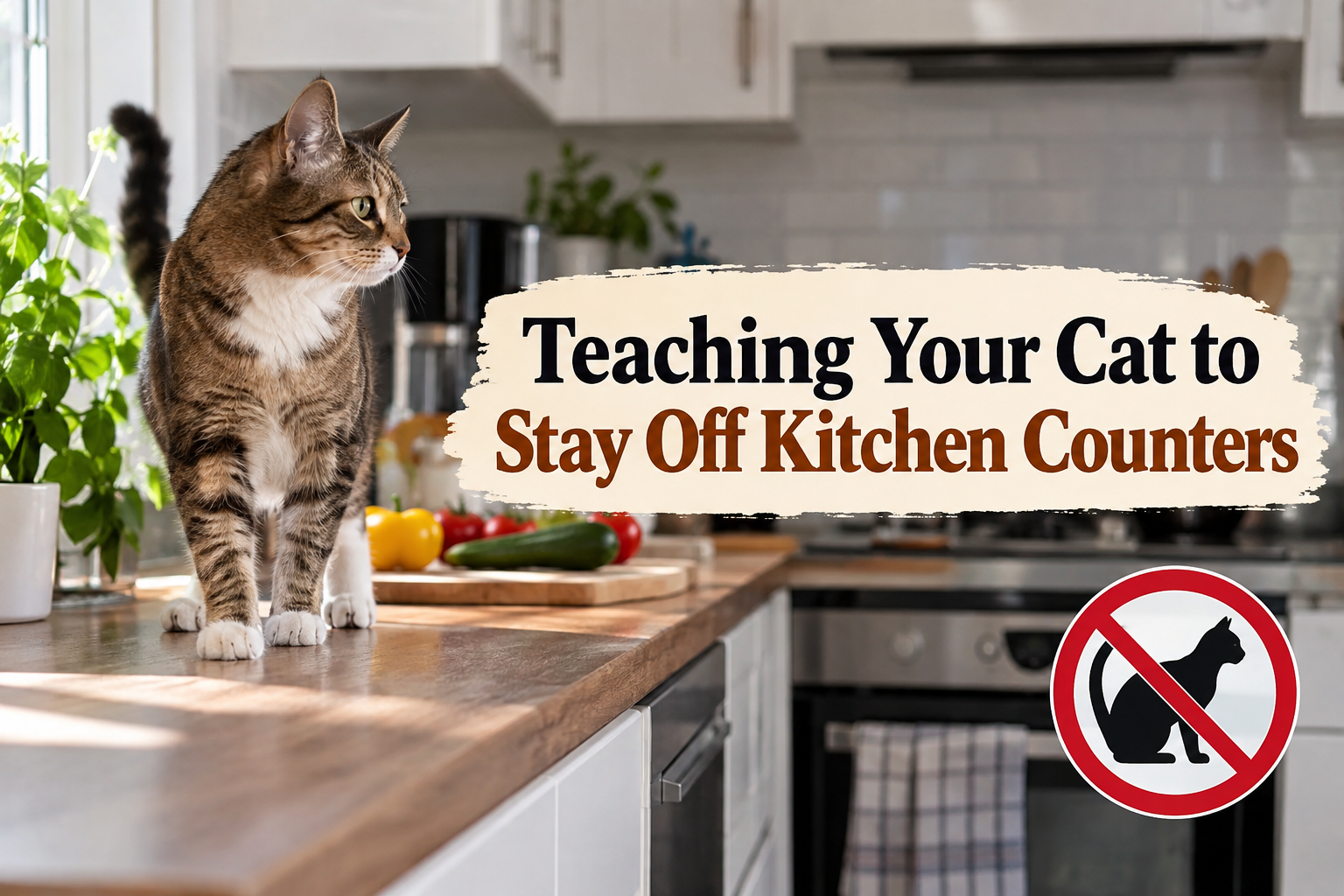
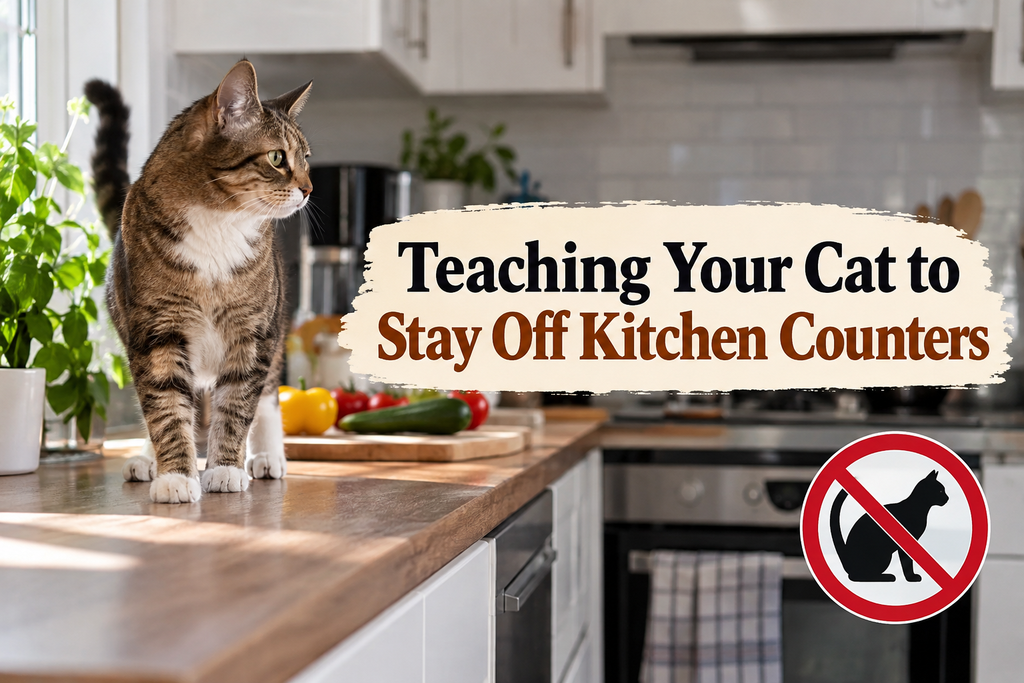
Cats are naturally curious animals. They love exploring high places, watching what people are doing, and investigating interesting smells. This is one reason why many cat owners struggle with the same frustrating problem: their cat keeps jumping onto the kitchen counter. At first, it may seem harmless, but allowing a cat to walk across food preparation areas can quickly become a hygiene and safety concern.
Teaching your cat to stay off kitchen counters is possible, but it requires patience and consistency. Cats do not usually respond well to punishment. They learn much better when we understand why they are doing something and provide them with a more attractive alternative. Once I started looking at cat behavior this way, training became much easier to understand.
The goal is not to make your cat afraid of the kitchen. Instead, you want your cat to learn that the counter is not rewarding while another nearby location is comfortable, interesting, and worth using.
Why Cats Jump on Kitchen Counters
Before trying to stop the behavior, it helps to understand why cats are attracted to counters in the first place.
Cats naturally enjoy being above ground level. In nature, height gives them a better view of their surroundings. A high location can help a cat feel safe and in control. Kitchen counters are often perfect from a cat’s point of view because they are high, wide, and usually located in one of the busiest rooms of the home.
Food is another major attraction. Even when the counter looks clean to us, a cat may smell tiny traces of meat, cheese, fish, butter, or other foods. A small crumb that seems unimportant to us can be extremely interesting to a cat.
Your presence can also make the kitchen counter more attractive. If you spend time preparing meals there, your cat may simply want to be close to you. Some cats learn that jumping on the counter gets immediate attention. Even saying no repeatedly can become rewarding if the cat enjoys interacting with you.
The first step in teaching a cat to stay off kitchen counters is therefore removing the reasons that make the counter so attractive.
Keep the Kitchen Counter Completely Clean
Food is one of the strongest rewards for a cat. If your cat jumps onto the counter and occasionally finds something tasty, the behavior becomes difficult to stop.
Clean the counter after every meal preparation. Remove food crumbs, dirty dishes, cooking utensils, and anything with a strong smell. Food should be stored in closed containers or inside cabinets and refrigerators.
Pay special attention to meat packaging, bread bags, butter dishes, and used plates. These items can quickly attract a curious cat.
It is also helpful to keep the sink clean. Some cats jump onto the counter because they find food particles inside plates or pans left in the sink.
When the kitchen stops offering unexpected food rewards, your cat gradually has fewer reasons to investigate the counter.
Provide a Better High Place
Simply telling a cat to stay down does not remove its natural desire to climb. A better approach is to provide another elevated location.
A cat tree can be extremely useful, especially when it is placed near the kitchen or dining area. A sturdy shelf, window perch, or safe piece of furniture may also work.
Choose a location where your cat can watch what is happening without needing to stand on the kitchen counter.
This is especially important for social cats. Some cats are not interested in stealing food at all. They simply want to watch their owner cook.
If your cat has an approved place nearby, encourage its use. When the cat sits there calmly, offer praise, affection, or a small reward.
Over time, the alternative location can become more appealing than the kitchen counter.
Reward the Behavior You Want
Positive reinforcement is one of the most effective ways to train a cat.
Instead of focusing only on what your cat is doing wrong, pay attention to moments when your cat makes the right choice.
Suppose your cat walks into the kitchen but stays on the floor. Give gentle praise. If the cat chooses its cat tree instead of jumping on the counter, reward that choice.
The reward does not always need to be food. Some cats respond well to affection, play, verbal praise, or access to a favorite toy.
The important part is timing. The reward should happen shortly after the behavior you want to encourage. This helps the cat understand which action produced the positive result.
With repetition, your cat begins to associate staying in approved areas with pleasant experiences.
Teach a Simple Down Command
Cats can learn simple verbal cues when training is calm and consistent.
If your cat jumps onto the counter, use the same word each time. You might say “down” in a calm voice.
Avoid yelling the command. Loud voices can frighten a cat without teaching the desired behavior.
You can encourage the cat to move toward the floor or an approved perch. Once the cat moves to the correct place, reward it.
Eventually, the word becomes associated with leaving the counter.
Training sessions should remain short. Cats often learn better through brief repetitions than through long training sessions.
Never Reward Counter Jumping Accidentally
Sometimes owners unintentionally teach their cats to continue jumping on counters.
Imagine that your cat jumps up while you are preparing chicken. You tell the cat to get down, but before doing so you give it a small piece of chicken.
From the cat’s perspective, jumping on the counter worked perfectly.
Even attention can become a reward. If your cat jumps up and you immediately start talking, touching, or playing with it, the cat may repeat the behavior simply to get your attention.
Try to make counter jumping as boring and unrewarding as possible.
When your cat moves to an appropriate location, that is when attention and rewards should appear.
Avoid Physical Punishment
Physical punishment should never be part of cat training.
Hitting, pushing, or frightening a cat can damage the trust between the cat and owner. It may also create anxiety without solving the original behavior.
The cat may simply learn not to jump on the counter while you are watching.
As soon as you leave the room, the cat may return.
Good training teaches a cat that the counter itself is not interesting, regardless of whether a person is present.
Calm redirection and environmental management usually produce better long term results.
Make Approved Areas More Interesting
If you want your cat to choose another location, make that area enjoyable.
Place a comfortable blanket on a nearby cat tree or perch. Add a scratching surface or favorite toy. A window view can make the location even more attractive.
Some cats enjoy watching their owners prepare meals from a safe distance.
You can occasionally provide a small reward when the cat chooses this location independently.
Eventually, your cat may start going to the approved place whenever you enter the kitchen.
This is much easier than constantly trying to stop jumping behavior.
Give Your Cat Enough Daily Activity
Bored cats often create their own entertainment.
A kitchen counter can become an exciting playground when a cat has little stimulation elsewhere.
Daily play can reduce unwanted behaviors by giving your cat a healthy way to use energy.
Interactive toys are particularly useful. Wand toys, soft balls, toy mice, puzzle feeders, and safe chasing games can keep a cat mentally and physically active.
Try having a short play session before preparing food. A cat that has recently played and eaten may be less interested in exploring the kitchen.
Mental stimulation is just as important as physical exercise. Cats enjoy activities that allow them to stalk, chase, investigate, and solve simple problems.
Establish Clear Rules From the Beginning
Consistency is extremely important when teaching your cat to stay off kitchen counters.
If one family member allows the cat on the counter while another person does not, the cat receives confusing information.
Everyone in the household should follow the same rule.
The counter should always be off limits, not only when food is being prepared.
Cats learn through patterns. When the same response happens every time, they begin understanding what is expected.
If the rules change from one day to another, training can take much longer.
Be Patient With Setbacks
Cat training rarely produces perfect results immediately.
Your cat may stay off the counter for several days and suddenly jump up again. This does not mean the training has failed.
Think about what may have changed.
Was food left on the counter? Was something interesting placed there? Did the cat have less playtime that day?
Small setbacks can help you identify what continues to motivate the behavior.
Simply return to the training routine.
Avoid becoming frustrated. Learning takes time, especially if your cat has been jumping on counters for months or years.
Pay Attention to What Happens When You Are Away
Some cats behave differently when nobody is watching.
You may think your cat has completely stopped jumping onto the counter when it has simply learned not to do it in your presence.
Keeping counters clean remains important even after training appears successful.
Remove anything that could reward unsupervised exploration.
You can also provide several attractive elevated locations around the home. When cats have plenty of appropriate climbing options, they are less dependent on kitchen surfaces for height.
Consider Your Cat’s Individual Personality
Every cat is different.
Some cats are highly motivated by food. Others care more about attention, climbing, or watching activity.
Understanding what motivates your own cat can make training much easier.
For a food motivated cat, preventing access to food is especially important.
For a social cat, creating a nearby perch may solve most of the problem.
For an energetic cat, additional play sessions may make the biggest difference.
There is no single technique that works exactly the same way for every cat. Successful cat training is often about observing behavior and adjusting your approach.
Keep Dangerous Kitchen Items Out of Reach
Teaching your cat to avoid counters is not only about cleanliness. Kitchens can contain serious hazards.
Hot pans, boiling water, sharp knives, electrical appliances, cleaning products, and hot cooking surfaces can all injure a curious cat.
Never assume that training alone will prevent every accident.
Keep dangerous items away from the edges of counters. Store knives safely. Do not leave hot cookware unattended when your cat has access to the room.
Cleaning products should also be stored securely.
Training and good kitchen safety should work together.
Build Better Habits Gradually
One of the biggest lessons I have learned about animal behavior is that habits usually change gradually.
You may notice your cat jumping onto the counter several times during the first few days of training. After consistent practice, that number may decrease.
Eventually, the cat may approach the kitchen and automatically choose its approved perch instead.
That is real progress.
Focus on building a routine rather than expecting instant obedience.
The more often your cat practices the correct behavior, the stronger that habit becomes.
Final Thoughts
Teaching your cat to stay off kitchen counters requires patience, understanding, and consistent training. Cats usually jump onto counters because they are searching for food, height, entertainment, or interaction with their owners.
Instead of relying on punishment, remove food rewards, keep counters clean, provide attractive climbing alternatives, and reward your cat whenever it chooses an appropriate location.
Daily play and mental stimulation can also reduce the curiosity that drives unwanted kitchen exploration. Most importantly, make sure everyone in the household follows the same rules.
Your cat may not change its habits overnight, but consistency can make a remarkable difference. When the kitchen counter becomes boring and another location offers comfort, attention, and a good view, your cat has a strong reason to make the better choice.
A successful approach to keeping cats off kitchen counters is not about controlling every movement. It is about understanding natural cat behavior and creating an environment where the right choice is also the most rewarding one. With time, patience, and positive reinforcement, you can enjoy a cleaner kitchen while maintaining a trusting and comfortable relationship with your cat.